Showing posts with label Debunking the Talent vs. Hard Work. Show all posts

Monday, November 17, 2025

What “Prodigy” Really Means in Haikyuu!! — And Why Oikawa Isn’t Called One Despite His Genius

A breakdown of Haikyuu’s definition of prodigy—and how fans misinterpret Oikawa’s talent and hard work.

Every fandom has its controversial topics, and in Haikyuu!!, one of the longest-running debates revolves around talent vs. hard work—especially when it comes to Oikawa Tooru.

Some fans insist Oikawa “isn’t talented,” often echoing his insecurities.
But if fans truly believe Oikawa is not talented, then they should be ready to argue with Iwaizumi and Coach Irihata, because the manga makes it very clear:

A breakdown of Haikyuu’s definition of prodigy—and how fans misinterpret Oikawa’s talent and hard work.
Haikyuu!! Manga ch. 60. Oikawa is talented 


A breakdown of Haikyuu’s definition of prodigy—and how fans misinterpret Oikawa’s talent and hard work.
Haikyuu!! Manga ch. 145. Oikawa is talented

Oikawa is talented.

The anime simply softened the wording by replacing “talent” with “ability”.

We have already explored this topic in the previous article—click here to read it in full.

This time, we will focus on a different question:
If Oikawa is talented, then why isn’t he called a prodigy?
Why did he even receive a chapter literally titled “Oikawa Is No Prodigy”?

Was it because he is less talented than he thinks?
Or is there another interpretation of “prodigy” that fans often miss?

Fans frequently treat “prodigy” as a synonym for “talented” or “gifted,” and that misunderstanding causes debates around characters like Oikawa to become messy, emotional, and sometimes disconnected from what Furudate-sensei intended.

But here’s the twist:

Oikawa is undeniably talented and undeniably a genius… yet he is NOT called a prodigy.

That isn’t an insult—it’s a distinction. And a very important one.

To understand why, we first need to break down what prodigy actually means in the world of Haikyuu!!.


Anime Cuts vs. Manga Details: Why Fans Misunderstand “Prodigy”

The anime skipped several subtle but crucial moments that help define the term:

  • Watari’s internal monologue calling Nishinoya a “prodigy.”

  • Kitagawa Daiichi’s shocked reaction when Kageyama revealed he started volleyball in 2nd grade.

  • The nuanced reasons characters sometimes call others “geniuses.”

A breakdown of Haikyuu’s definition of prodigy—and how fans misinterpret Oikawa’s talent and hard work.

These missing details matter because they reveal something important:

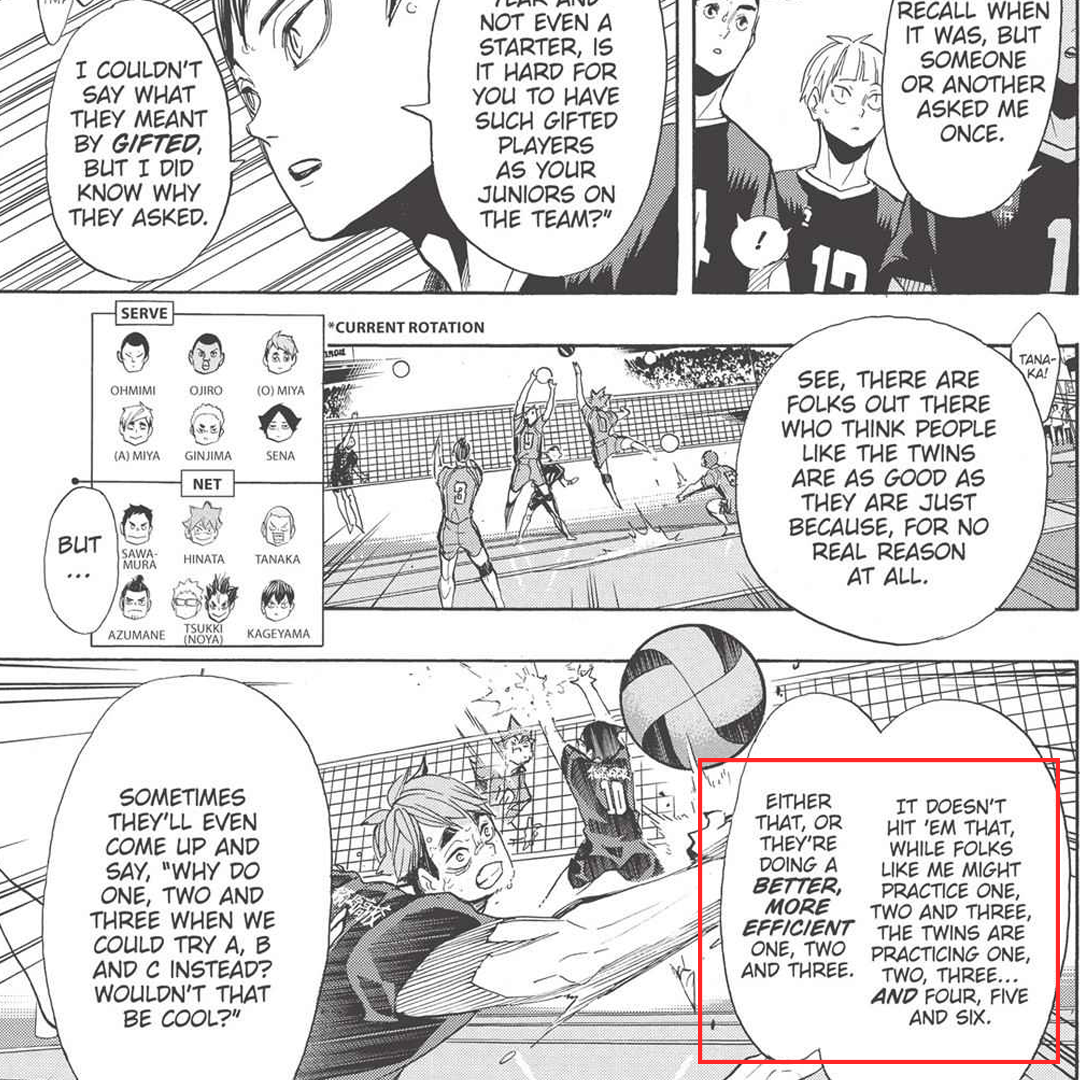
In Haikyuu, someone is called a “prodigy” when they started much earlier and mastered the fundamentals long before everyone else.

  • Nishinoya had been training as a libero since middle school.

  • Kageyama had structured volleyball training years before most of his peers even touched a ball.

This is why Watari and others react the way they do. Not because Nishinoya or Kageyama were “born perfect,” but because:

They simply had a head start—and it paid off.


**Prodigy ≠ Gifted

Prodigy ≠ Talented
Prodigy ≠ Born Perfect**

A prodigy is someone who:

started early + trained seriously + invested long hours before others even began.

It is not about being born with special traits.

To make it easier, think of it this way:

**Being born in a royal family makes you royal by status…

but it doesn’t automatically make you behave like royalty.**

You still need to:

  • learn etiquette

  • study diplomacy

  • train in leadership

  • practice public behavior

  • develop discipline

Similarly, in Haikyuu:

  • Starting early doesn’t guarantee excellence.

  • Being gifted doesn’t guarantee success.

  • Being a prodigy doesn’t erase the need to work hard.

A prodigy isn’t someone who magically excels—they’re someone who had more time and a stronger foundation to develop their skills.


So Why Isn’t Oikawa Considered a Prodigy?

A breakdown of Haikyuu’s definition of prodigy—and how fans misinterpret Oikawa’s talent and hard work.

Because Oikawa didn’t start at the extremely early age that other characters did, nor did he receive high-level coaching from childhood.
Despite being interested in volleyball since he was young, Oikawa only began learning properly in middle school—supported by Iwaizumi’s own words.

He wasn’t a “volleyball royalty” who had a built-in head start.
He wasn’t molded by elite coaching systems from a young age, even though he trained his serve by himself.

Instead:

  • He started on the same starting line as most normal students, following the middle-school curriculum where teenagers first explore and develop their interests.

  • He improved steadily.

  • He discovered his strengths gradually.

This is exactly why characters like Iwaizumi and Coach Irihata use the word “talent” to describe him—not “prodigy.”

He is gifted.
He is athletic.
He is brilliant.
He is a genius by Kita’s definition (someone who works harder than normal people).
But he is not a prodigy.

And that’s not a downgrade—it’s a characterization.


Breaking Down the Definitions (Haikyuu-Style)

Through Furudate’s writing and interviews, these terms gain consistent meanings:


1. Gifted = Born with special traits

A breakdown of Haikyuu’s definition of prodigy—and how fans misinterpret Oikawa’s talent and hard work.

Examples:

  • Ushijima’s left arm

  • Oikawa, Bokuto, Asahi’s athletic build

  • Sakusa’s wrist flexibility

  • Hinata’s natural coordination

  • Height advantages (Tsukishima, Hyakuzawa)


2. Luck = Environmental advantages

A breakdown of Haikyuu’s definition of prodigy—and how fans misinterpret Oikawa’s talent and hard work.

Examples:

  • Supportive teammates (Osamu → Atsumu, Iwaizumi → Oikawa)

  • Good coaches

  • Early discovery of volleyball

  • Strong school programs

Nearly every major character has some form of luck.


3. Talent / Genius = Works harder than average (Kita’s definition)

A breakdown of Haikyuu’s definition of prodigy—and how fans misinterpret Oikawa’s talent and hard work.

Examples:

  • All Monster Generation players

Talent here is not passive—it’s earned through abnormal effort.


4. Prodigy = Started early + trained seriously

Examples:

  • Youth Camp members

  • Kageyama (started in 2nd grade)

  • Ushijima (also started early)

  • Nishinoya (libero training since middle school)

Prodigy is about time and foundation, not natural gifts.


The Bigger Picture: Everyone at the Top Is Talented

By the end of Haikyuu!!, characters like:

  • Hinata

  • Kageyama

  • Oikawa

  • Ushijima

  • Atsumu

  • Bokuto

  • Sakusa

  • Hoshiumi

  • Romero

  • Iizuna

  • Joffe, etc.

…all reach elite levels.

They are all talented geniuses, each with unique strengths and obstacles.

Furudate even stated that he gave Hinata extraordinary jumping ability to compensate for his late start and short height.
Likewise, Iwaizumi emphasized Oikawa’s naturally athletic body—a supportive factor that helped him catch up to those who started earlier.


So, Are We Still Arguing About Talent vs. Hard Work?

Once the terms are properly understood, the debate becomes much clearer:

  • Prodigy = early start + consistent training

  • Gift = natural physical advantages

  • Talent / Genius = abnormal hard work

  • Luck = supportive environment

  • Results = the unique combination of all the above

Oikawa is not a prodigy.
But he was born with gifts—and he worked hard to sharpen those gifts so he could catch up to players who started volleyball much earlier than him.

Understanding these distinctions helps us appreciate each character’s journey—without diminishing others.


Monday, June 9, 2025

Debunking the Talent vs. Hard Work Debate in Haikyuu!!: What Furudate-sensei Really Thinks

If you’re a Haikyuu!! fan, you’ve probably stumbled upon countless posts classifying characters into two camps: Talent vs. Hard Work. Characters like Kageyama, Hoshiumi, Tsukishima, and Atsumu are often labeled as “talented,” while others are praised for their relentless effort. But have you ever wondered what Haruichi Furudate, the author of Haikyuu!!, actually thinks about this popular debate?


The Common (fans, not author) Classification: Talent vs. Hard Work

Many fans eagerly place characters into neat categories:

  • Talent: Kageyama, Hoshiumi, Atsumu, Tsukishima, Sakusa, Ushijima 
  • Hard Work: Commonly Oikawa and Hinata

But what if this black-and-white classification misses the point? Furudate-sensei’s own interviews suggest a much more nuanced perspective.

Furudate-sensei’s Take on “Talent” and “Genius”

In interviews, Furudate-sensei has addressed the concept of “genius talent” directly—especially in relation to Oikawa’s character. He expected that Oikawa’s comments about talent would spark debate among fans, and interestingly, he acknowledges that this can lead to a negative perception of a character like Kageyama and Ushijima.

Furudate-sensei's Interview

To clarify, Furudate-sensei uses multiple characters’ points of view—like Kita Shinsuke’s and the Miya twins’—to show that what looks like “talent” from one angle might be “hard work” from another. Yet, many fans still missed the subtlety, prompting him to use the main character, Hinata, to clarify things in chapter 338.

Ch. 338

Why the Talent vs. Hard Work Debate Is Misleading

If you’re frustrated by posts that pit Haikyuu!! characters against each other in this way, take heart: Furudate-sensei is on your side. He’s not endorsing a simple “talent vs. hard work” narrative."

"So why did he have Oikawa make statements about “talent” and “genius” if he didn’t believe in that dichotomy?" 

Here’s where Akaashi’s perspective helps. Furudate-sensei wants to remind us that everyone is the protagonist of their own story. That means the story offers us:

  • A character’s point of view (subjective and personal)
  • A third-person point of view (objective and rational, for the reader)

Different Perspectives on the Same Character

Take Kageyama, for example:

  • From Oikawa’s point of view, Kageyama is a talented genius.
  • From Hinata’s point of view, Kageyama is the hardest-working person he knows.
  • From Oikawa’s point of view, Kageyama is a little brat. 
  • From Atsumu’s point of view, Kageyama is initially an obedient child, though this view evolves."

This multiplicity of perspectives encourages readers to think critically and not accept any single viewpoint as absolute truth.

Oikawa’s Bold Declaration: Not a Foreshadowing

With this multiplicity of perspectives, we can be sure that Oikawa’s confident claim about defeating Japan isn’t a foreshadowing of future events. From his perspective, being accepted on a team that beat Japan in 2016 means he’s on a stronger team, which fuels his confidence.

Different POV offers different view

But from an objective, third-person perspective, Japan’s national team underwent massive changes after 2020, making Oikawa’s statement less about prophecy and more about his personal mindset at that time.

Behind the Scenes: Oikawa and Kageyama’s Roles in the Story

Interestingly, Oikawa was not a “planned” character from the start. As the story progressed, editors grew fond of him, and he became one of Furudate-sensei’s favorite characters to write—alongside Hinata, Atsumu, Tanaka, and Bokuto.

In contrast, Kageyama was a “planned” character, designed to represent many aspects of Furudate-sensei himself. This makes Kageyama a key figure for delivering the story’s deeper messages. Misunderstanding Kageyama’s role could lead to misinterpretations of the entire narrative, which is why Furudate-sensei has taken care to clarify these points.

In summary:

Don’t get caught up in the simplistic “talent vs. hard work” debate. Haikyuu!! encourages us to appreciate multiple perspectives, understand the complexity of its characters, and recognize that everyone’s journey is unique. Furudate-sensei’s storytelling invites us to look beyond labels and embrace the nuanced reality of growth, effort, and personal meaning.

Therefore, from Kita Shinsuke’s point of view, talented or geniuses are those who worked harder than normal people. So, whose POV do you use when classifying Haikyuu characters? Will you use Oikawa’s POV or Kita Shinsuke’s POV? 

Haikyuu!! Talent vs. Hard Work


Haikyuu!!: Redefining Talent Through Oikawa and Kageyama


In the world of Haikyuu!!, the concept of “talent” is never simple. It shifts depending on whose perspective you use—be it the character’s, a coach’s, or even the audience’s. In this article, we’ll dissect the age-old debate between Talent vs. Hardwork, two of the series’ most talked-about players: Kageyama Tobio and Oikawa Tooru. But before we begin, here are a few important clarifications:
  1. This analysis uses a third-person point of view, not Oikawa’s.

  2. Setting skill and being a setter are not the same thing.

  3. Even a four-hour breakdown wouldn't be enough to define a player's “setter-ness.”

  4. We're evaluating them as volleyball players, not as setters.

Part 1: Early Development and the “Head Start”

When did they start playing volleyball?

Kageyama at three years old, Oikawa isn't stated

  • Kageyama began as early as 3 years old.

  • Oikawa’s starting age isn’t stated, but…

We know from his conversation with Coach José Blanco that he didn’t take volleyball seriously until middle school. It’s implied that during elementary school, it was more of a casual hobby.

By 2nd grade, Kageyama was already receiving proper training, likely through a dedicated training center. Oikawa, on the other hand, only began structured training during his first year of middle school, meaning Kageyama had a 3-year head start.

Kageyama started in 2nd grade, Oikawa started in Middle School

Despite this, by the time they reached high school, Oikawa was self-claimed to be better in areas like spiking, serving, and blocking. His versatility led Iwaizumi to describe him as “naturally talented”—a critical piece of this discussion.


Part 2: The 'Talent' Oikawa Sees in Kageyama

To truly understand this debate, we need to examine how Oikawa himself views Kageyama.

In Season 1, there’s a moment where Oikawa outright calls Kageyama a “genius”. This isn't just flattery—he’s referring to Kageyama’s game sense.

This idea resurfaces in Season 2, where Kageyama instinctively sends a tight set to Hinata during a critical moment. Oikawa recognizes this move as genius—but here’s the twist: when Oikawa performs a similarly brilliant play, he describes it as “instinct.”


Why does he downplay himself?

Because Oikawa has long convinced himself that he lacks innate talent. Even when he mirrors the brilliance of players like Kageyama or Ushijima, he chalks it up to sheer effort—not giftedness.

But from a third-party perspective, the truth is more balanced.

Kageyama’s sharp instincts didn’t appear overnight. They were refined through constant practice, observation, and self-discipline. He studied volleyball videos, kept a training journal, and never skipped a moment of improvement, not even when Oikawa was out resting on every Monday.

How Kageyama built his game sense


So, if Oikawa’s instinct is the result of hard work, Kageyama’s has been honed even longer.


Part 3: The POV That Shapes “Talent”

Here’s the real crux of the discussion: whose point of view are you using to define “talent”?

  • From Oikawa’s POV, Kageyama is the talented one.

  • From Kageyama’s POV? He probably doesn’t even understand the word "talented".

  • From Iwaizumi’s POV, both Oikawa and Kageyama are talented.

  • From Coach Irihata’s POV, Oikawa eventually earns recognition as a talented player.

And then there’s Kita Shinsuke, who offers a unique lens. In Season 4, he says that a true genius is someone who works harder than most people. By this logic, not just Kageyama, but even Hinata qualify as shown in the manga.

Hinata is also considered genius by Kita Shinsuke's POV

This opens the door to an important realization: if Hinata, who has only played volleyball for less than a year, is considered talented by Kita Shinsuke, then so is Oikawa.


Part 4: Natural Gift vs. Earned Advantage

Let’s circle back to Oikawa’s claim: despite starting volleyball later, he became better than Kageyama in several areas.

How?

Because natural gifts still matter. Oikawa is taller, which makes him more effective at blocking and spiking. This is similar to Hinata, who was born with a rare speed advantage no one else can match.

This reminds us again of Iwaizumi’s statement—Oikawa was born with a better physical body than most. It’s a situation similar to Hinata, who was the only one born with such incredible speed.

This doesn't mean that Oikawa is the only one born with a naturally athletic body. But when comparing Oikawa and Kageyama, Oikawa clearly has the advantage.

Oikawa was born with athletic body and Hinata was born with incredible speed and athletic abilities


Yes, it’s an advantageous situation where you can’t choose whether you’re born with it or without it. In other words, a "gift"—or as Ushijima calls it, “luckiness."

Does that mean Kageyama and Hoshiumi don’t have 'luckiness'?

If we only define “luckiness” as being born with something, then yes, Kageyama and Hoshiumi don't have the same gifts as Oikawa and Hinata.

Almost everything about Kageyama is the result of self-maintenance:

  • He forced his body to keep up with older athletes (shown in ch. 387 Haikyuu Mange).

  • He trained hard to gain strength (there is a dumbbell in his room).

  • He grew taller through deliberate nutritional care (he was one of the shortest in middle school!).

Hoshiumi shares a similar journey. Unlike Hinata, he wasn’t born with reflexes or speed—he became great through endless repetition and adaptation.

BUT, even though Kageyama and Hoshiumi were born more ordinary compared to Oikawa and Hinata, they still have their own form of “luckiness”:

They found volleyball early.

Their passion and early exposure to volleyball are their own advantage. If they hadn’t found it so early, they might not have been able to grow at the same pace as Oikawa and Hinata.

Then again, referring back to the second explanation, if we only focus on Kageyama's and Hoshiumi's POV on how “ordinary” they were at birth, we might think they’re in a more pitiful situation.

But using a third perspective, we can fairly say: They were also lucky, just in a different way. They were lucky to be introduced to volleyball early enough to compensate for their disadvantage.

In the end, it's a fair comparison.

So, in conclusion, judging characters solely through “Talent vs. Hard Work” is flawed. There are too many factors to define what “talent” really is, and each POV tells a different story."

So, how do we define it?

Maybe the better way is: "Gift and Luckiness."

Whether it’s being born with a gift—or being born into a lucky situation.


It Was NEVER About Talent! Oikawa vs. Kageyama


 A Rivalry Beyond Talent

We could call Oikawa the best setter in the prefecture.
We could say he brings out the best in his team.
We could even call him the ideal setter everyone longs for.

But in Oikawa’s eyes, he would—and will always—be wary of Tobio.
He will always believe that one day, Tobio will surpass him.
Simply because we don’t see what Oikawa sees.


We could say Tobio has surpassed every setter he has faced.
We could call his hands magic.
We could say he is a genius—the King of the Court.

But in Tobio’s eyes, he would—and will always—be wary of Oikawa.
Because in his mind, Oikawa is still ahead.
Simply because we don’t see what Tobio sees.


Oikawa’s Perspective

Oikawa has always known that Tobio’s setting skill surpasses his own. Yet, this realization does not unsettle him. Volleyball is not a game won by individual brilliance alone—it is a team sport, where synergy, communication, and strategy hold just as much weight as raw skill. Oikawa understands this better than most.

To someone like Oikawa, players like Tobio possess an analytical edge—the ability to see possibilities that others might overlook.

He saw this firsthand during Tobio’s final match at Kitagawa Daiichi—the moment that led to Tobio’s downfall. Alongside Iwaizumi, Oikawa watched as Tobio’s exceptional vision clashed with his inability to lead.

Oikawa witnessed Tobio's downfall

But Oikawa saw more than just an overbearing setter. He noticed that Tobio recognized Kindaichi’s potential for a broad attack. He saw that Tobio understood Kunimi’s capability to move for the ball—more than just conserving stamina, Kunimi could do so much more.

Tobio knew Kindaichi's broad attack potential

Tobio knew Kunimi's potential

Oikawa knew that Tobio had the vision to unlock their potential, but his inability to connect with them held him back.

Despite knowing that Tobio struggles with communication, this knowledge does not bring Oikawa comfort. Because Oikawa is certain—once Tobio overcomes his mental hurdles, once he fully learns how to bring out the best in his teammates—he will stand on the same level as Oikawa. And if Tobio continues at his current pace, he will surpass Oikawa in the blink of an eye.


Kageyama’s Perspective

People call Tobio a genius. They praise his accuracy, his technique, his King Toss. But what is the use of a perfect toss if the spiker will not spike it?

For someone like Tobio, players like Oikawa have an invaluable gift—communication. The ability to inspire, to guide, to make others follow their lead effortlessly.

Tobio saw this during the first and second Seijoh vs. Karasuno match. He watched as Oikawa executed Kindaichi’s broad attack—the very same attack that had been designed for Kindaichi to use back in middle school. He saw how Oikawa pushed Kunimi to move for the ball—something Tobio had wanted Kunimi to do, but no matter how hard he tried, Kunimi wouldn’t listen.

Oikawa executed Kindaichi's broad attack

Oikawa was able to push Kunimi

Tobio realized that Oikawa can unify a team in a way that feels as natural as breathing.

Oikawa can unite the team

Even though people recognize and admire Tobio’s skillset, it does not put him at ease. Because he knows—no matter how much he improves his communication, no matter how well he learns to express himself—it will never match Oikawa’s ability to command a team. Oikawa will always be ahead in this regard, simply because he was born with this innate charisma.


Conclusion: A Battle of Insecurities

Their insecurities are not just about volleyball. They are deeply human struggles.

Psychologically, extroverts like Oikawa may feel insecure when compared to introverts, fearing that they lack introspection, depth, or observation skills.

Meanwhile, introverts like Tobio may feel insecure about their perceived lack of social skills, struggling with group interactions in ways that extroverts find effortless.

Strengths and Weaknesses 

In short conclusion, Oikawa and Iwaizumi believe Kageyama is a volleyball prodigy. But what they don’t realize is that Kageyama didn’t just wake up as a genius—he’s been playing since he was a toddler. By the time he joined his middle school club, he was already skilled enough to be seen as a prodigy.

Manga Chapter 387

On the other hand, Kageyama never had real friends. Volleyball was his entire world, leaving him blind to social cues. That’s why Oikawa’s extroverted leadership both amazed and intimidated him.

Manga Chapter 387

In the end, both Oikawa and Tobio bring out the best in their teams, but through different means.

  • Oikawa leads through communication. His outgoing nature draws attention, allowing him to guide his team with energy and charisma. His presence makes people listen, follow, and trust him.
  • Tobio leads through trust. His unwavering focus, intensity, and precise play force his teammates to rise to the challenge, even if he does not vocalize it. His presence pushes them to give their all.

Both are exceptional. Both are vital. And both are constantly learning from each other—pushing one another to new heights.

Final Notes:

  • Extroverts can still develop deep observation skills. With training, they can refine this ability.
  • Introverts can also lead teams. With maturity, they can develop leadership in their own unique way.
  • Both Oikawa and Kageyama have grown past their insecurities—but they will always be cautious of each other.